
The populist, extreme-right-wing party is gaining significant attention among voters in the UK. Nigel Farage’s growing recognition is becoming a threat to the major parties- the Conservatives and Labour. A study by YouGov, released on May 27, showed that Reform is in first place, standing 10% ahead of the Conservatives and 8% ahead of Labour (Independent, 2025). What led to high support for the extreme right party? This article will explain the reasons behind the reform vote and its implications for Britain’s politics.
Background
The history of the extreme-right-wing party dates to before the 2016 referendum; in 1993, Alan Sked founded the UK Independence Party (UKIP), with the primary aim of increasing Euroscepticism in the UK and campaigning for Brexit (EBSCO, 2025). The UKIP was set up to fight the Maastricht Treaty (The Guardian, 2024). Under Alan Sked’s leadership, they aimed to run a candidacy in the 1997 UK elections. However, they did not do as well as James Goldsmith’s Referendum Party. After the failure, Alan Sked resigned, leaving space for others who wanted to join the party (The Guardian, 2024).
After the 1997 elections, James Goldsmith died. This gave space for UKIP’s uprising. At a time, the leader of the party, Nigel Farage, became famous by advocating for stricter immigration policies and an anti-EU narrative (EBSCO, 2025). However, after the 2016 referendum, UKIP’s influence declined, leading Nigel Farage to leave the party in December 2018. Afterwards, the Brexit Party was founded in early 2019 to ensure the Brexit process was completed clearly and decisively. When the need for a “clear” Brexit was no longer a priority, the Brexit Party was rebranded as Reform UK in 2021 to encompass a broader political agenda (Britannica, 2025).
The Reform UK
As Andrew Rawnsley (2025) argued, “told that there’s been a gas leak in the building, Nigel Farage is the guy who fires up a cigarette. There’s no situation so combustible that he can’t contrive to try to make it more frightening”. Based on Rawnsley (2025), fear-based messaging is the style of Farage’s policymaking. Like other far-right leaders, for example, Trump in the U.S., Nigel Farage also works on the fears and emotions of citizens to further his agenda. In the last few months, people seem to try to give Reform a “chance”, as their disappointment grows with the Labour and the Conservative parties. Is he worth a chance? Populist leader, or “a man with no policies beyond protest”? We will discuss some of Reform’s “popular” policies, which received high controversy in the UK.
Immigration Policies
By 2024, the UK’s net immigration was 728,000, triple the number from a decade before, with net immigration of 252,000 (Electoral Calculus, 2024). These numbers are making the immigration issue one of the main concerns of voters. Labour Prime Minister Starmer also mentioned the risk of the UK becoming an “island of the strangers” (Electoral Calculus, 2025), to reassure citizens who are against high immigration numbers. Even though Labour is considered a left-wing party, stricter immigration policies were also on their agenda. The primary concern of the UK’s voters has been illegal boat crossings, which reflect broader public dissatisfaction with the government’s handling of immigration (Independent, 2025).
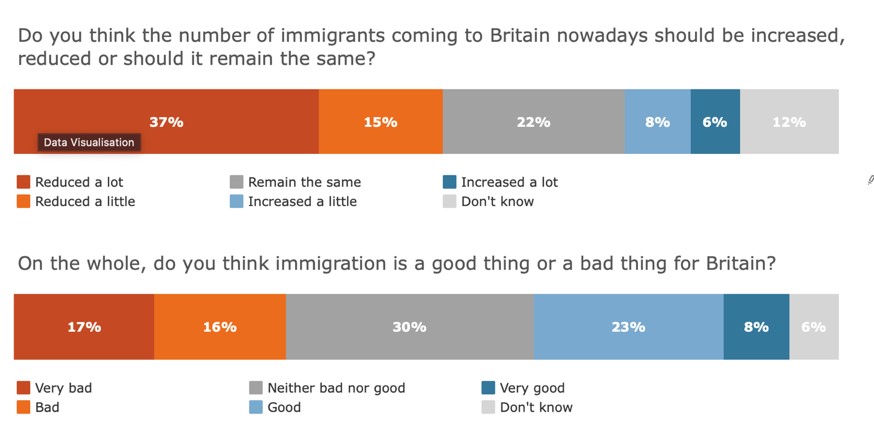
According to the data from the Migration Observatory in 2023, 37% of citizens think that immigration should be significantly reduced, and 17% of people think that it is a “terrible” thing for Britain (Migration Observatory, 2023). Only 6% of people thought that immigration has to “increase a lot”. This made immigration policies the main populist agenda for every party in the opposition and the government.
As the graph below shows, as the age of people increases, negative views towards immigration become more common. However, when it comes to university degrees, only 7% of university graduates think that immigration is very bad, while 22% of people with no university degree view immigration as very negative. The reason behind this might be that university graduates could be stronger candidates for the jobs on the market and having been exposed to diverse cultures during their studies, are more likely to be accepting of people of different nationalities.

Popularity Myth
Reform UK’s core pledges include stricter immigration controls. Although they advocate for reducing overall immigration, they claim to “acknowledge” the need for exceptions in areas like healthcare (BBC, 2024). They want to “freeze” non-essential immigration and are planning to ban students from bringing their partners and children to the UK. Employers hiring foreign workers would be required to pay a 20% National Insurance rate—higher than the 13.8% rate for British workers—with exceptions made for the health and social care sector and tiny businesses. By the figure 2 and figure 3, people who are dissatisfied with current immigration issues might vote for Reform in the next elections, as they might think that this would “control” immigration in the country. According to the Independent’s survey, 27% of Conservative voters have shifted their support to Reform UK, while 66% are still backing the Conservatives. More concerning for Labour, only 60% of those who voted for them in 2024 are sticking with the party. Meanwhile, 15% now plan to vote for Reform, 12% have moved to the Liberal Democrats, and 9% to the Greens. These statistics are making Reform one of the most popular parties in the UK.
Economics of Farage
Turning to another key aspect, as for their economic policies, they propose significant tax cuts, including raising the income tax personal allowance to £20,000 and the higher rate threshold to £70,000 (IPRR, 2024). The Reform party also aims at cutting corporation tax to 15% over time. They plan to scrap the inheritance tax for estates under £2 million and remove VAT on energy bills. To fund these changes, they would cut £150 billion in government spending, including on welfare, foreign aid, and green energy subsidies. The main idea is to “prioritise national growth” over international cooperation.
This is an expansionary fiscal policy, aiming to stimulate the national economy. Raising the income tax threshold to £20,000 could be suitable for the middle class, as it would lower income taxes. Cutting corporate taxes to 15% could be beneficial for businesses, as it might encourage investment. However, the economy might lose a significant amount of money, because taxes are at their current high level. After scrapping the tax for the estate, the middle class and the upper middle could benefit; however, there is a high risk that it would worsen wealth inequality.
Foreign Policy
Reform, like other right-wing parties, suggests more “isolation” of Britain, meaning less involvement in foreign affairs. As the main ideologist of Brexit, Nigel Farage aims to reject the UK’s involvement in foreign conflicts. They are viewed as an anti-globalist party, emphasizing the “British cultural heritage”, rather than international cooperation. In years when Russia started a full-scale invasion on the continent, not cooperating with ongoing conflicts will be impossible for Reform party, making their agenda more populist, rather than realistic. As one of Ukraine’s main supporters, the UK cannot realistically end foreign aid and doing so would represent a misguided policy given the ongoing war in Europe.
What if…
No one would be able to fully state what Reform would do if they came to the government, as they have never been in the government before, which makes it harder to predict their actual policies. However, given the chaos they caused during Brexit and their populist rhetoric, it is difficult to tell which policies they will actually implement. In my view, members of the Reform Party engage in populist tactics, appealing to public emotions and dissatisfaction, and using events like wars and economic crises to their advantage.

